
Carroll County Criminal Court Cases
Carroll District Court handles misdemeanors, violations, traffic and ordinance cases, arraignments, and felony probable-cause proceedings. Circuit Court has general felony jurisdiction. A felony can therefore appear first on a District Court docket before moving to Circuit Court after an indictment or information. Carroll County belongs to Kentucky's 15th Judicial Circuit and District.
Circuit Court Clerk Gloria Belcher keeps the local Circuit and District files at William L. Wheeler Hall of Justice. Kentucky does not operate a separate municipal court for Carrollton, Ghent, or Sanders. Under KRS 83A.065, city-ordinance offenses go to District Court, so the unified clerk counter is also the right court-record starting point for those matters.
The prosecution office also depends on court level. Carroll County Attorney Nicholas Marsh handles District Court allegations, while Commonwealth's Attorney Leigh Ann Roberts handles felony prosecutions in Circuit Court. Those offices litigate cases, but neither replaces the clerk as custodian of the court record. Requests for a docket, judgment, or certified order still go to the clerk.
Carroll County's Unified Court Record Counter
The Circuit Court Clerk serves as the local custodian even though the two courts perform different jobs. The office is at 802 Clay Street, Carrollton, KY 41008, and is open Monday through Friday from 8 a.m. to 4:30 p.m. The published phone lines are 502-732-4305, 502-732-4306, and 502-732-4307. Calling first helps identify the court level and whether the file is still onsite.
The official Carroll County Court page introduces the Hall of Justice and the clerk's contact details.
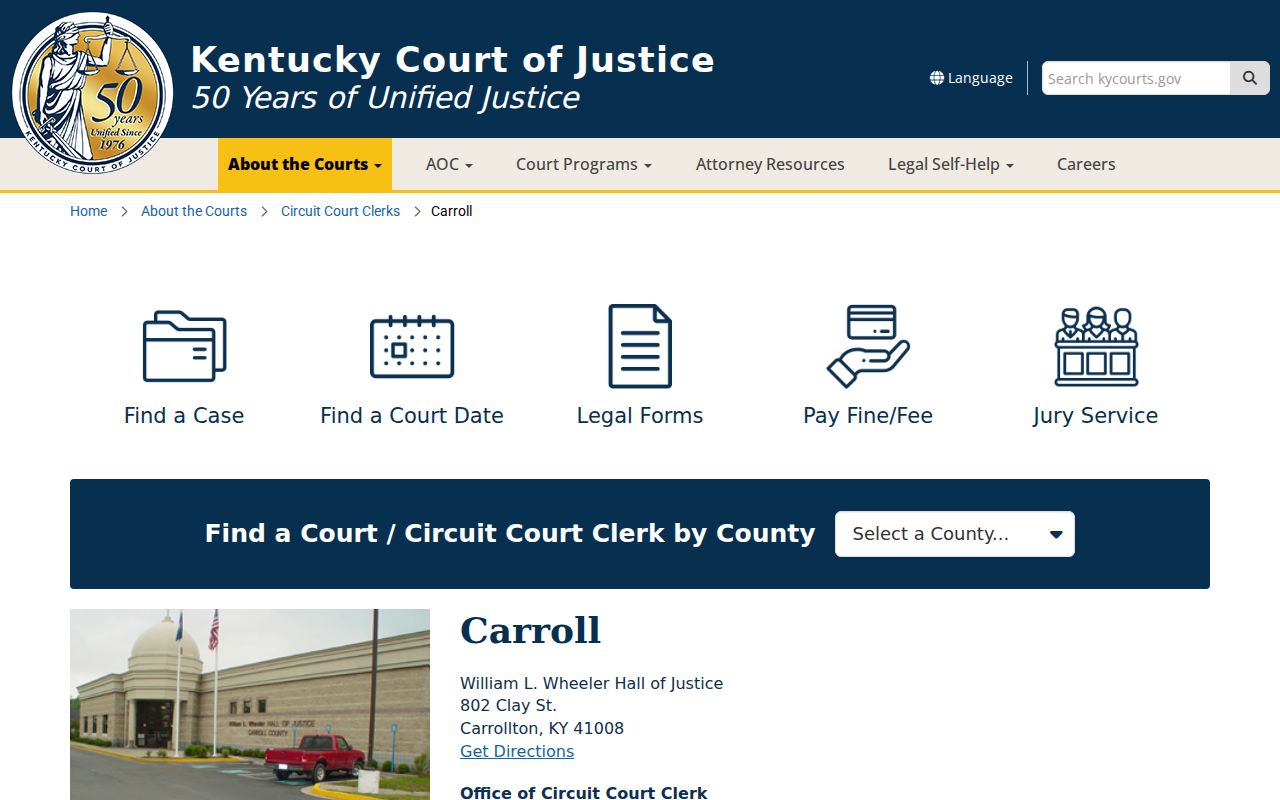
This local office, rather than the AOC central office, holds the original Carroll County criminal case file and supplies certified local copies.
Searching Carroll County Case Records
KYeCourts Guest CourtNet provides free public case information after its entry gate and reCAPTCHA. Treat the online result as a lead, not as a substitute for the signed order or full docket. The research could verify only the entry controls because reCAPTCHA blocked inspection of a live case search, so unconfirmed fields should not be assumed.
- Open Guest CourtNet, pass the entry gate, and use the available case-search controls.
- After entry, use only the controls the live system presents; the research could not verify those post-gate fields.
- Treat any public result the system returns as a lead rather than a certified account of the case.
- Call the clerk with the name, case number, and court level to confirm location and availability.
- Request the exact pleading, order, judgment, docket, or certified copy needed from the clerk.
| Field Label | Type | Required | Notes |
|---|---|---|---|
| “I'm not a robot” | Google reCAPTCHA | Yes | The verified entry gate must be completed before the guest search opens. |
| Continue | Button | Yes | Opens the guest-search area after the gate is cleared. |
| Post-gate search controls | Not inventoried | Unverified | reCAPTCHA blocked responsible inspection, so no field names or filters are assumed here. |
The captured Guest CourtNet entry screen shows the official gateway used for a Carroll County case lead.
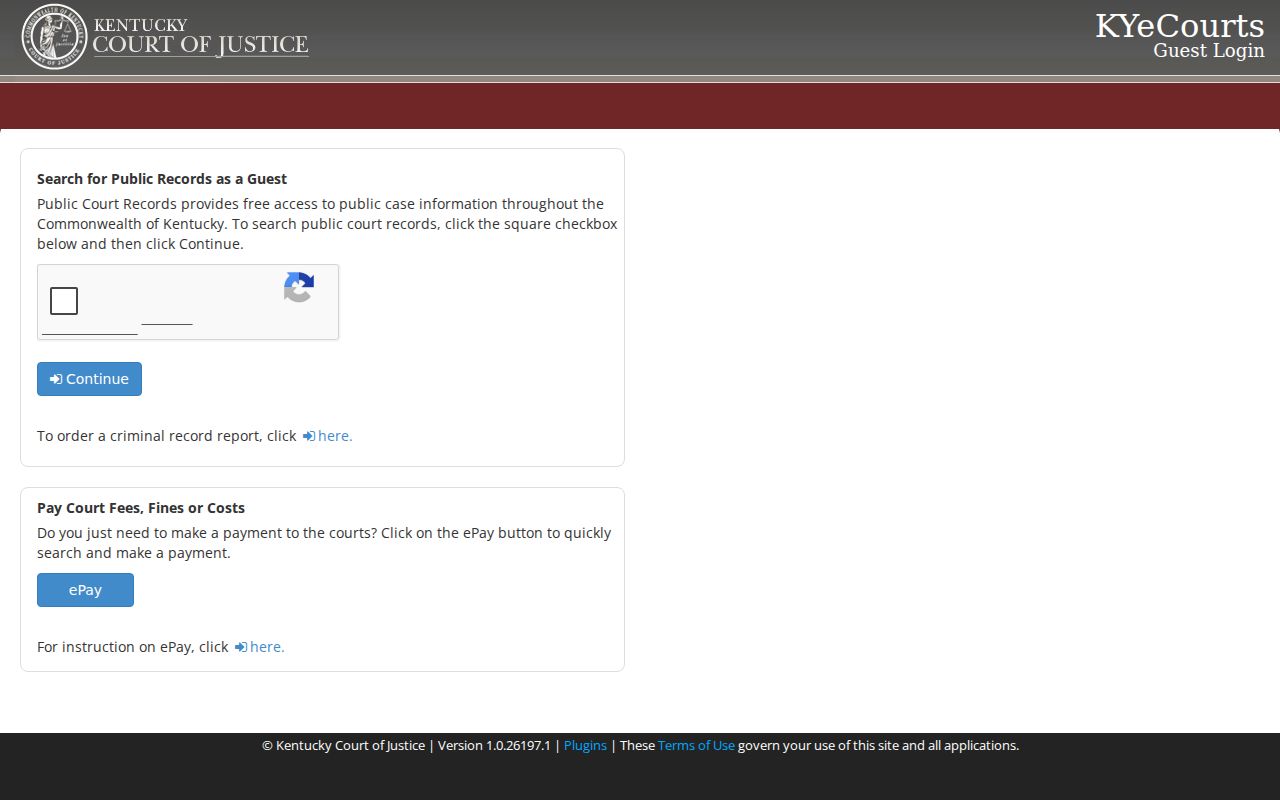
The gate is the online starting point, while the Carroll clerk confirms the file and supplies the requested court document.
If the name search is uncertain, work from an official citation, court notice, or booking entry that supplies the spelling and case reference. Then ask the clerk to confirm whether the matter is District or Circuit. This avoids joining records from people with similar names and keeps the request tied to one court case rather than a broad person search.
Older Carroll County Criminal Case Files
An older case may have moved to a state records facility or may fall under an approved retention schedule. The State Records Center cannot search court holdings by a person's name or Social Security number. The Carroll County clerk must first locate the matter and provide both the case number and file locator number needed for a stored-file request.
Ask whether the case is at 802 Clay Street or in storage before traveling. Describe a specific record, such as the final judgment, sentencing order, motion, or complete docket, instead of asking for an undefined “criminal history.” The Kentucky Court of Justice request instructions explain that court files can contain citations, pleadings, motions, orders, evidence, reports, dockets, recordings, and transcripts.
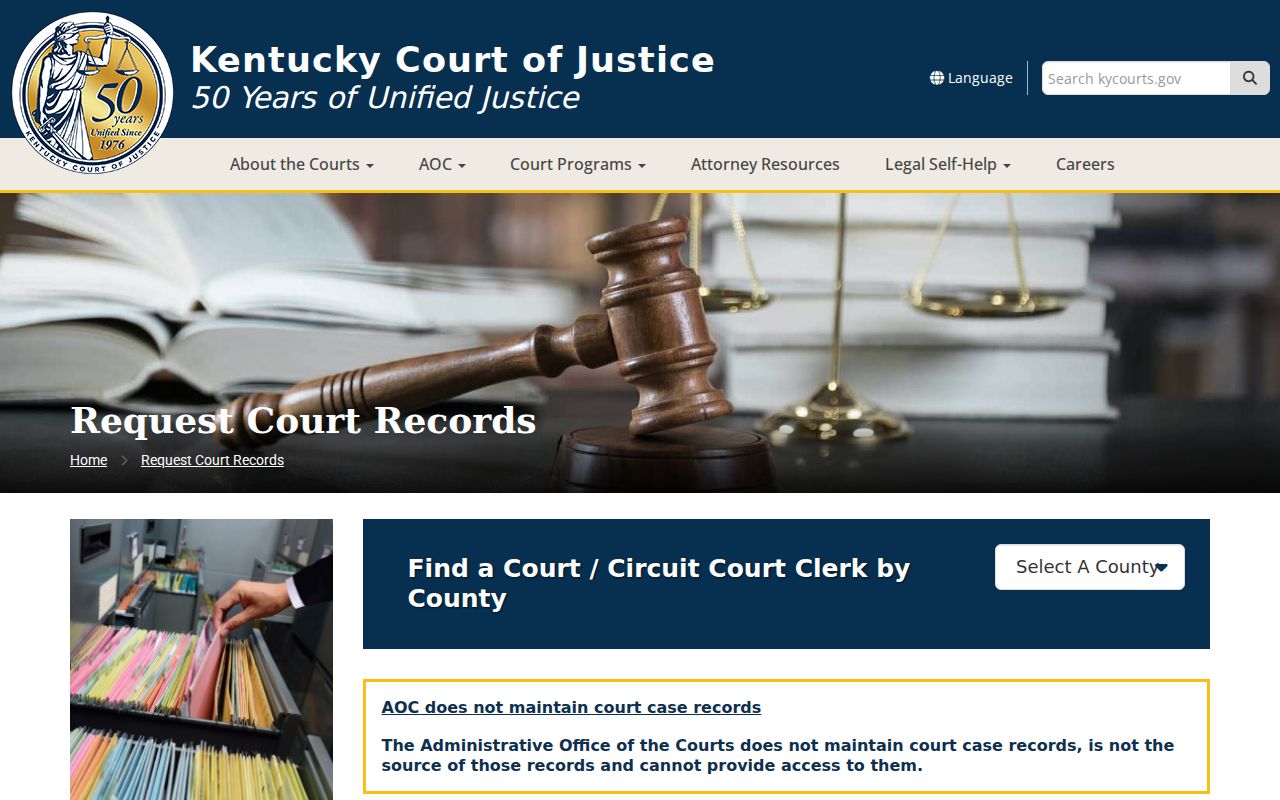
That request channel helps define the record, but the Carroll clerk remains the point of contact for the original local criminal case file.
Inside a Carroll County Case File
A case file is organized around a prosecution rather than a person's whole history. It records the court, case number, filed charges, hearings, motions, rulings, disposition, and sentence. A court report may summarize selected fields, while the original Carroll County file can contain the papers and recordings that explain how the case reached its result.
| Case Number & Court | Identifies Carroll District or Circuit Court and ties every filing to one prosecution. |
|---|---|
| Charging Document | Shows the original or amended charge, KRS citation, class, and charge date. |
| Docket Entries | Lists filings and events in date order, including motions, orders, and court action. |
| Hearing Dates | Tracks arraignment, probable-cause, pretrial, plea, trial, and sentencing events when applicable. |
| Disposition & Judgment | States the outcome and disposition date, such as conviction, dismissal, diversion, or another procedure. |
| Sentence & Conditions | Records confinement, probation, fines, costs, restitution, and other terms ordered by the court. |
Public copies redact protected data. Social Security and tax identification numbers are hidden except for the last four digits, month and day of birth are concealed while the year may remain, and full financial account numbers are not displayed. Victim and minor information may also be sealed or redacted.
The case-centered format also prevents a common mix-up. A booking file focuses on intake, custody, initial allegations, bond, and release. A KSP repository product follows a person and reported criminal-history events. The Carroll County court file follows one prosecution and shows which allegations were filed, changed, or resolved by judicial action.
Reading Carroll County Case Outcomes
Disposition labels should be read charge by charge. “Convicted” reflects a judgment of guilt. “Dismissed” means the charge ended without conviction. “Diversion” is a supervised alternative that may lead to dismissal. FTA or FTV records a failure to appear or failure to verify, not a finding that the underlying charge was proved.
Carroll Circuit Criminal disposed 213 cases in FY2024 involving 328 felony-level and 11 nonfelony charges. Among the felony charges, 190 were convicted, 77 dismissed, 34 placed in diversion, 21 marked FTA/FTV, and 6 resolved by administrative procedure. These are counts of cases and charges, not unique people, so they cannot be used as a headcount or crime rate.
Note: A docket status is a procedural label; the signed judgment or final order supplies the authoritative result.
How a Criminal Case Moves
A Carroll County criminal case begins as a court matter when a complaint, citation, indictment, or information is filed. District Court conducts arraignments and felony probable-cause proceedings as well as misdemeanor cases. A felony prosecution moves to Circuit Court after formal charging. Pretrial motions and plea discussions appear on the docket before a plea, trial, or other disposition, followed by sentencing when there is a conviction.
Case flow: Charges Filed › Arraignment › Pretrial › Plea or Trial › Disposition › Sentencing
The court chain explains why booking allegations and filed charges may differ. Prosecutors can amend or decline allegations after review, and the docket then reflects the charge the court actually handled. For the arrest and custody side of the event, use the separate Carroll County arrest lookup.
No Municipal Criminal Court in Carroll County
A citation for a Carrollton, Ghent, or Sanders ordinance does not lead to a separate city courthouse or municipal docket. Kentucky's unified court structure places city-ordinance offenses in Carroll District Court. That means a searcher should use Guest CourtNet and the Circuit Court Clerk at Wheeler Hall, even when the event began with a city ordinance or a Carrollton Police citation.
City Hall may hold the ordinance or an administrative record, and the responding police agency may hold its incident report. Neither record states the final court outcome. The District Court file supplies the filed charge, hearings, rulings, and disposition. Keeping those custodians separate prevents a city-record request from being mistaken for a criminal case-file request.
Carroll Court File or AOC Report?
A free Guest CourtNet result, a paid AOC statewide report, and a certified Carroll County file answer different questions. Guest CourtNet offers a quick case lead. AOC FastCheck or One-Time Request supplies a statewide court-record report. The clerk's file provides the actual local docket and requested documents, and the clerk is the source for certification.
| Channel | Best Use | Limit |
|---|---|---|
| Guest CourtNet | Finding a public Carroll County case lead | Online information is not the complete certified file. |
| AOC FastCheck / One-Time | Statewide court-record summary | AOC does not hold the original local case file. |
| Circuit Court Clerk | Pleadings, orders, docket, judgment, recordings, and certified copies | Stored files may require locator numbers and added retrieval time. |
A person reviewing a Carroll County outcome should match the report's county, case number, original or amended charge, disposition, disposition date, and clerk memo to the original file when precision matters.
Case Record Access & Restrictions
Kentucky's public-access rules do not make every court detail public. Juvenile matters, sealed and expunged records, victim identifiers, protected personal identifiers, fingerprints, DNA, and some investigative material are restricted. KRS 61.872 provides access to nonexempt public records for Kentucky residents, while KRS 61.878 identifies exemptions and KRS 17.150 governs criminal-justice records.
An absent online result does not prove that no case exists. Ask the clerk whether the spelling, court level, filing stage, storage status, expungement, or access restriction explains the gap. If a public request is denied, the custodian should identify the legal basis. A paper file may contain more than the online view, but protected content remains redacted in either form.
Qualifying acquittals, dismissals, misdemeanors, and Class D felonies may be removed or restricted through Kentucky expungement procedures. Once an order is carried out, the public search may no longer display the case. AOC can retain limited restricted order data for future eligibility work, and prosecutors may retain a nonpublic law-enforcement record, but those records are not ordinary public case-search results.